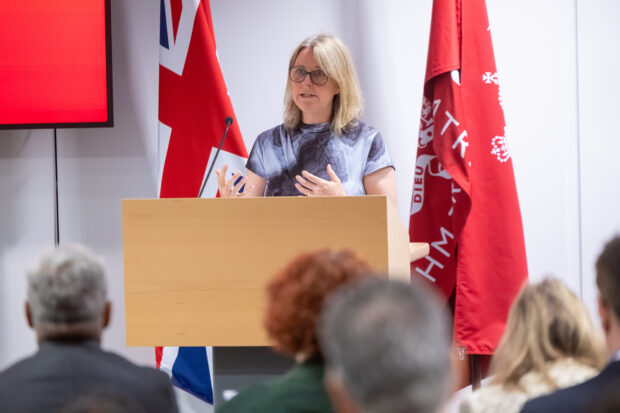
What does a decade of UK Financial Sanctions look like in practice? At the end of April, to mark its 10th anniversary, OFSI hosted an international conference on sanctions, bringing together partners and stakeholders from across UK government, industry and international allies including the EU, US, Ukraine, Australia, Japan, Canada and the Cayman Islands.
The conference demonstrated OFSI’s ability to convene a cross-sector group of partners, and, as many attendees noted, this created a more distinct forum than is typical. By bringing these partners together in one forum, OFSI had the unique opportunity to set out its new strategy openly, to support practical discussions on the shared challenges facing the sanctions community and pointing towards a clear pathway to strategically address these.
In her address, Lucy Rigby MP, Economic Secretary to the Treasury and OFSI’s lead Minister, emphasised that sanctions are not just about imposing restrictions, they also protect the integrity of the UK’s financial system and help ensure legitimate businesses are not undercut by illicit actors. Describing financial sanctions as an integral part of the UK economy, she underlined their role in supporting national resilience and maintaining the UK’s global reputation. She also pointed to a more complex geopolitical landscape, with links between developments in Russia and the Middle East, and the need to maintain sustained pressure on Russia for its illegal war in Ukraine, while managing wider risks to the global economy. She highlighted the importance of making better use of data and continuing to work collectively as threats evolve.
This direction was echoed by Lindsey Whyte, HM Treasury’s Director General International, and Permanent Secretary James Bowler, who both reflected on the strain on the international order and the central role sanctions now play, which require strong partnerships across government and with industry nationally and internationally.
The evolution and importance of the UK sanctions regime
Over the course of the day, panels explored how the UK’s sanctions framework has evolved and where it goes next. The first session, moderated by OFSI Deputy Director Daniel Drake, reflected on the shift from operating through the EU to delivering an autonomous UK framework. This capability was tested at pace in February 2022, when more sanctions were introduced in a few months than in the previous decade, driving significant change across government and industry.
As Daniel noted, OFSI is now “entering its teenage years” with stronger capabilities, deeper partnerships, and a clear role in delivering national security outcomes.
Across industry and international perspectives, what came through clearly was how much the system has matured. Firms described a shift from basic screening to highly sophisticated, proactive approaches, while international partners highlighted the UK’s credibility across implementation and enforcement. At the same time, the landscape continues to change, with increasing legal complexity, more sophisticated evasion tactics and ongoing pressure to strengthen capability and technology.
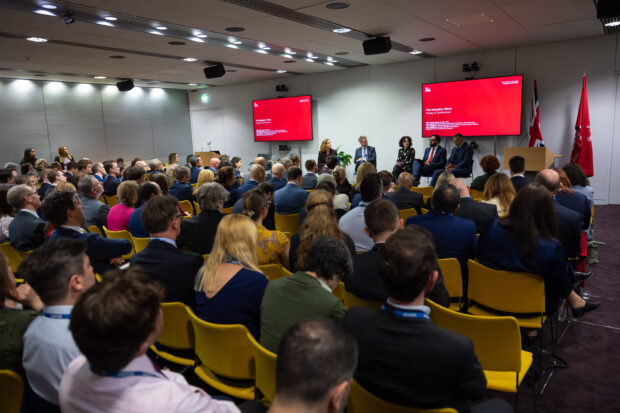
The Industry Perspective
The industry panel, moderated by OFSI Deputy Director Beth Davies, offered a candid view of how sanctions are applied in practice. Panellists highlighted the scale of investment firms have made in building sanctions capability, alongside the challenge of operating in a changing environment, where certainty is not always clear-cut and professional judgement is often required. Visible enforcement is seen as critical in shaping behaviour, while continued dialogue between government and industry remains essential, particularly in managing overcompliance and ensuring policy intent is understood.
Partnerships at the core of sanctions delivery
The penultimate panel, moderated by OFSI Director Giles Thomson, highlighted the importance of international partnerships for the effectiveness of sanctions. Speakers from the US, EU and Cayman Islands were clear that sanctions are most effective when applied collectively. Alignment across jurisdictions increases impact, whilst practical cooperation through intelligence sharing and regular engagement underpins delivery. Maintaining this alignment requires constant effort, particularly as new challenges emerge, including dynamic evasion techniques and the growing use of crypto assets.
Looking ahead: the next decade of sanctions
The final panel looked ahead to the future. Speakers focused on how technology will shape the future of sanctions. Advances in artificial intelligence and data are creating new opportunities to strengthen analysis, coordination and decision-making. However, panellists noted the need to be accountable for using these tools carefully, ensuring speed and scale does not come at the expense of sound human judgement. The discussion highlighted a more complex operating environment, where sanctions, anti-money laundering and fraud are increasingly interconnected. The conclusion was clear: rapid technological change will demand that the system modernises ways of working to keep ahead of circumvention and evasion, and to take full advantage of new capabilities to deliver greater impact, without losing the role of human judgement.
How OFSI delivers: PERC in action
A consistent thread running through the day was how the four pillars of OFSI’s new strategy - Promote, Enable, Respond and Change (PERC) - are being delivered in practice.
The licensing spotlight highlighted the importance of enabling legitimate activity whilst maintaining pressure on designated targets, supported by clearer guidance, targeted use of General Licences and a structured prioritisation approach. The enforcement session reinforced the value of visible action in driving compliance, with more targeted investigations and increased publication of outcomes helping to shape behaviour across the system.
Feedback since the event has reinforced the value of bringing together such a broad mix of partners, allowing for what many commented felt like a different kind of conference. The range of perspectives and experience ensured meaningful, open, practical discussions about shared challenges and the future of sanctions throughout the day.
Closing the conference, Director Giles Thomson reflected on both progress across the decade, and the importance of maintaining momentum: "Financial sanctions are, at their core, a collective endeavour. They are only as strong as the system that implements them, and that system only functions because of the people within it. "
The pace of change since 2022 has been significant, but the foundations now in place leave the UK well positioned for the future. Ultimately, the day reinforced a simple point: sanctions are not delivered by any one organisation alone. Their effectiveness depends on the collective efforts of government, industry and international partners and it is that shared effort which will define the next decade as much as the last.
To learn more about OFSI’s strategy and our Promote, Enable, Respond and Change (PERC) framework, read the full document here: OFSI Strategy: 2026 - 2029 - GOV.UK